Note: I have yet again changed my idea for the Ken Burns assignment because I thought the earlier one was still too cheesy.
The link to my script is here.

Tuesday, February 15, 2011

Sunday, February 13, 2011
Presentation 3 (Scripting)
Select a minimum of 5 pages from each script and analyze them:[In this blog post, I will be adding screenshots of the script to illustrate my observations of the scripts.]
1. Up
Being a major Pixar fan, I decided to focus this week's question on the animated feature film Up. I really liked how Pixar painted his story emotionally, artistically and visually.. so it was really a treat to be able to read this script.

My focus will be from pages 1 to 10, the beginning part of the film.
I chose this portion because it's one of my favourite parts of the movie - the background story of the protagonist Carl.
Pages 1 to 10 of the script shows Carl's young interest (which was indeed his life-long interest!) in exploring and how he's a die hard fan of Charles Muntz. Carl also meets a girl named Ellie, also passionate about exploring, who enthusiastically befriended him..and unintentionally landing him in hospital.
The script ends just about the time when the film moves onward to the montage of how they got married and grew old together.
I was hoping to be able to obtain some clips from Youtube to compare between the script and the final product, but there wasn't any useful ones I could find, so.. I guess we'll have to make do without them. Go watch the DVD!
1. Which are the characters/roles in this script?It is clear to see that the characters are usually given a bit of an introduction, and then highlighted just before their dialogue (i.e. the words they are supposed to speak). In notation, they are usually bold, capitalized and center-aligned.
1st character: Charles Muntz


Here, Muntz is described as a dashing young adventurer.
In here, the Newsreel Announcer isn't a character, but I think he has a role to play in the script, i.e. the voice over. Is there such a thing as a voice over character? Off screen character?
2nd character: Carl Fredrickson


Carl is also given a small introduction (about his age, so that the artists know how to design him) and then given a dialogue here.
3rd Character: Ellie
 Ellie is given a more detailed description here.
In here, the Newsreel Announcer isn't a character, but I think he has a role to play in the script, i.e. the voice over. Is there such a thing as a voice over character? Off screen character?
2nd character: Carl Fredrickson
Carl is also given a small introduction (about his age, so that the artists know how to design him) and then given a dialogue here.
3rd Character: Ellie
Ellie is given a more detailed description here.Point out the voice over
Voice overs are noted using "(V.O.)" in this script.

 O.S. stands for "Off Screen", which means that the voice belongs to a real character in the scene, and not just a narrator. The voice exists in the film's world and also IN THE SCENE, just that he/she has not appeared yet.
I've looked through most of the script carefully and there isn't any camera movement for this script, sadly. But there are quite a few in Avatar, which I will talk about and show later.
Point out the camera movement
Point out the transition
 Denotes a "dissolve" or "crossfade" video transition.
 These denote a "cut" to the next scene.
Usually, a change in scene happens when the surroundings are different, which can be seen in e.g. "EXT. SMALL TOWN NEIGHBOURHOOD STREET" and "INT. CHURCH - DAY", which I will explain in the next question.
How does it present place and time?

 In these cases (and also throughout the script and most other scripts), INT. means an interior setting (or indoors) and EXT. means exterior (or outdoors).
Then, the exact place is specified, e.g. "Small Town Neighbourhood" or "Carl's Room".
Next, the time is specified, e.g. "Day" or "Night"
Of continuous, here's what I got off a website: some writers use "KITCHEN - CONTINUOUS" to emphasize the regular flow of time. But that's not necessary. Instead, CONTINUOUS is best used for stylized scenes where a conversation or action continues right across several Locations.
2. Avatar

My focus of the analysis will be from pages 53 to 58.
CharactersJust like in the script for Up, the characters are center-aligned and highlighted in bold for their dialogue. Otherwise, they are presented in just caps in action/details paragraphs (i.e. non-dialogue).
Character: Tsu-Tey (Tribe warrior)

Character: Trudy (Military woman)

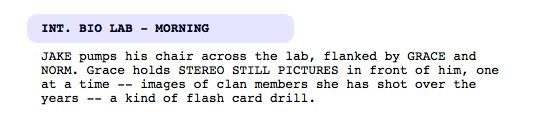
Characters: Jake (main character), Grace and Norm
 In here, also note that their names appear in CAPS in the action/details paragraph.
Character: Neytiri (tribe princess) & Tsu-Tey

Character: Max

Characters: Jake, Colonel Quaritch and Selfridge


Character: Trudy (Military woman)

Characters: Jake (main character), Grace and Norm
 In here, also note that their names appear in CAPS in the action/details paragraph.
Character: Neytiri (tribe princess) & Tsu-Tey

Character: Max

Characters: Jake, Colonel Quaritch and Selfridge

Voice OverThere aren't much voiceovers in these scenes.. In the movie, I think the only voiceovers occur when Jake was doing his video log. So this is just one of it.
The voiceover is denoted with a (V.O.).

TransitionThe following snapshots show the video transitions. (consists of mostly Cuts)

Here, we have a Cut To the next scene.
 A series of jump cuts - probably to drive home the point that Jake keeps falling and failing for many many times. This series of cuts also happen quickly (no pauses).
 A cut to the next scene.
"OPS CENTER - NIGHT" refers to the place/time of the next scene.
CameraHere are some camera angle notations in the script.
 A wide aerial camera angle of the Samson among the floating islands. This wide angle shows the vastness of the place (although CG generated).
 A tight shot of the horse's tendrils. A tight shot also refers to an extreme close up.
 The camera focuses on Norm, a character.
 The camera points at Jake, the main character.
 Here, we have camera angles from Jake's point of view (POV) and the camera pointing at him.
 A close up (CU) on Jake's Avatar.
 The camera shooting at an angle on Max. Probably a high or low angle.
Together with a Cut transition to the next scene.
Place/TimeThe following show the various place/time of the different scenes



Difference between scripts before production vs ready for production?
Well, I haven't been able to find a substantial answer online, but I guess upon observation of the scripts in IMSDB, I think that there is a difference.
Firstly, I noticed that the scripts in IMSDB are labelled with "Draft", "Shooting Script" etc. which I assumed that there are indeed different stages in script writing.
Ok, so just to zoom in and illustrate the differences using examples, I found Addams Family (shooting script..which I think would be the script that is ready for production) and Hancock (draft).
Well..... I guess the main difference between the two is that normally, in drafts, we don't find camera information (i.e. how to camera ought to behave when shooting etc..whether it's wide angle, or close up etc). Like in the previous question, the script for Up is also a draft and there isn't any camera information there.
I think the purpose of the draft would just be for the directors/producers etc to know how the story will unfold in detail. I suppose it also gives actors/crew to know roughly how the film is going to be like without too much details (kinda like the flavour of the movie). In fact, I think (just guessing) that before the actual shoot, actors come together to voice out their dialogues to see how they fit together and set the mood, hence they might be using the draft version for this case. Obviously, there won't be a need for the full script with camera info for this.
It will also be best to note that not all drafts in IMSDB are without camera info as in fact some do, e.g. Clash Of The Titans.
Thursday, February 10, 2011
Assignment 2 Update - Newest Idea
Ok, so right now after my previous failures in generating ideas for this assignment, I've come up with a new idea! It might sound just a little bit cliche...but I think it's more interesting than any of my previous ideas.
The title is gonna be:
"What Do You Want?"
Here's a rough script (I'll tighten it up and add some storyboards later):
The title is gonna be:
"What Do You Want?"
Here's a rough script (I'll tighten it up and add some storyboards later):
- "Do you wanna make friends? Enlarge your circle? Or find that special one?
[show pics of friends, networking and romance!] - "Do you crave challenges? Seeking opportunities to get a taste of the outside world?"
[show pics of internship] - "Do you want to have recreational time, doing things you love alongside academics?"
[show pics of CCA, sports, etc] - "Do you like to excite your tongue? NUS offers a variety of cuisine and lowered prices so you get to enjoy good food without burning a big hole in your pocket!"
[show pics of food] - "Are you a big fan of nature? Do you want to be in an environment surrounded by fresh air and greenery?"
[show pics of nature around NUS] - [ending]
"For academics, friends, activities and recreation, XXX people have chosen NUS. What about you?"
Wednesday, February 9, 2011
Assignment 2 Update
Apologies for not being able to have a detailed concept earlier on.. but I guess CNY's no excuse!
So anyway, the class decided that I should go ahead with idea #2, but maybe jazz it up a little.
Which I then thought of using a song, changing the lyrics for my script...
BUT BUT BUT
Julian said it's not possible!
I've already written out 85% of the lyrics....
T-T
Ok, this means I've really really gotta brainstorm for ideas........
Dear God, help me!
So anyway, the class decided that I should go ahead with idea #2, but maybe jazz it up a little.
Which I then thought of using a song, changing the lyrics for my script...
BUT BUT BUT
Julian said it's not possible!
I've already written out 85% of the lyrics....
T-T
Ok, this means I've really really gotta brainstorm for ideas........
Dear God, help me!
Tuesday, February 8, 2011
My Ken Burns (ideas) - in point form
I have 2 ideas:
1)
NUS "ROCK"
R - Rapport (Friends)
O - On the ball (mugging)
C - Cheap Food
K - Keep fit (climbing stairs, walking from block to block)
2)
My 4 years (more honest!)
1st year - Orientation photos, CCA, STRESS, learning how to bid on CORS
2nd year - Decided to persevere, appreciate the food, explore more of NUS
3rd year - Make more friends, getting used to CORS
4th year - Getting the hang of modules, more project work, internship & GRADUATION!
Will probably end with a quote:
"Life in NUS may not be a bed of roses,
but I learnt through the thorns..."
1)
NUS "ROCK"
R - Rapport (Friends)
O - On the ball (mugging)
C - Cheap Food
K - Keep fit (climbing stairs, walking from block to block)
2)
My 4 years (more honest!)
1st year - Orientation photos, CCA, STRESS, learning how to bid on CORS
2nd year - Decided to persevere, appreciate the food, explore more of NUS
3rd year - Make more friends, getting used to CORS
4th year - Getting the hang of modules, more project work, internship & GRADUATION!
Will probably end with a quote:
"Life in NUS may not be a bed of roses,
but I learnt through the thorns..."
Sunday, January 30, 2011
Week 2 Presentation - On Video Transitions
I.
http://www.youtube.com/watch?v=cULOFcZ93Ug
- Point out the part(s) that applies Ken Burns Effect.
- Which part(s) of using Ken Burn Effect you think are (is) good?
- Evaluate this video from other aspects (sound, photo, script, transition and so on). Which are (is) good and which can to be improved?
Map of NUS (0:10 - 0:12)
I think this is pretty ok given that the map already showed the cropped section of NUS FASS, however, the image moving from left to right makes it confusing because it felt like the audience was 'dropping of the edge'. It would have been better if the motion was zooming in instead.
Pics of stairs (0:20 - 0:26)
I like that the moving pictures of the stairs followed the shape/flow (if there is such a thing) of the stairs, e.g. going from bottom to top (cos that's how we climb the stairs from the bottom angle). There is also another zooming-out picture of the stairs and I think all these effects serves to slowly reveal just how many steps there are to take and gives the audience an element of surprise! I'm kind of picturing in my head that they'll go, "Wow, when are the stairs gonna end?... What there's still more?"
Looking up at a stairs (going up/zoom out) (0:27 - 0:34)
I liked that when the image of Cheryl looking up the stairs from behind was shown, the image was moving upwards because it would be like the natural way of looking at the stairs first from the bottom then upwards to see where it ends.
I felt that it was also appropriate for the image of Cheryl's face (the "not again!" part) to be zooming-out..I felt that it was effective in capturing her emotions at that point of time rather than zooming-in. I think it was because someone would imagine her screaming (imagine drawing lines from her mouth outwards to the edges of the screen..like a comic effect, if you know what I mean).
Food hankies (0:44 - 0:46)
I think there isn't any special meaning behind the Ken Burns effect, but I do think that the effect does give it a nice touch rather than just leaving it static.
Looking at books & mugging (0:58 - 1:08)
I think that the Ken Burns effect of the images of Cheryl looking at the pile of books and later on in her study materials was good because the motion followed the vision-line of her eyes.
Evaluation of the video.
I think that the script was done very well. It was interesting, engaging (her voice was very energetic) and definitely puts an honest testimony of what it's like to be a regular NUS student. I think the photos were done very well too (and the effort in taking them was commendable). Also, the concept of using people to hold onto the papers with letters was unique and interesting.
However, I think she can work on her laughter. At some points, her laughter/chuckle seemed very muffled and suppressed.. so it does sound 'forced' or 'fake to some extent. I think by relaxing and being confident of her voice/laughter would really help to improve the quality of the video, because it becomes something really personal and not staged.
You know what, I think she can probably even just remove the laughter bits altogether.
II.
What are the types of video transition?
- Please list 5 different video transition effects (see the Adobe Premiere menu). When should these transition effects be used? What are the meaning attached to each transition effect?
- Please find 5 clips which illustrate when these five effects are used, and their meaning/purpose [The meaning of the direction: From left to right [the good guy], from right to left [the bad guy], an example from tonight’s lecture]. If you cut the clips from your DVD, please put these clips in your A2 folder i.e., in addition to your answers you write in the blog. (tips: you can find videos from YouTube; you can also cut your own movies).
1. Cross dissolve
Meaning attached: Across a certain time span.
When should it be used: When trying to show different shots in which there is a time lapse in between them.
(5:17 - 5:22 from http://www.youtube.com/watch?v=VDlsGm59xHc&feature=related); the passing of time as Harry waits for his turn while the other contestants went for their turn.
2. Dip to black
Meaning attached: Across an even longer time span.
When should it be used: As in #1, but probably when there is a longer time lapse (e.g. a few hours or even days). It can also be used between different acts or scenes. A fade out draws more attention to the passing of time while dissolve does not.
(1:09 - 1:11 from http://vimeo.com/groups/stopmotion/videos/12155835); to signify a passage of time as the bottle flows to the other character.
(See: 1:09 - 1:11)
Bottle from Kirsten Lepore on Vimeo.
3. Push
Meaning attached: A change to a different scene.
When should it be used: When we want to change a scene creatively/to a different scene with a different setting or at a different time.
(0:37 - 0:42 from http://www.youtube.com/watch?v=KCyMT3eXs7c); used to change the scene into a flashback.
(See: 0:37 - 0:42)
4. Iris
Meaning attached: A round moving mask that can close down to end a scene (iris-out) or open to begin one (iris-in), which by doing so reveals more space in the scene (in iris-in) or focuses on one point while eliminating other details (in iris-out).
When should it be used: starting or ending a scene (with a particular focus point in the scene and eliminates other elements in the scene). (quoted from Yale Edu)
http://classes.yale.edu/film/videos/Iris-Neighbors.wmv
5. Additive dissolve
Meaning attached: There is sort of like a flash of light when this is used, probably to signify a 'magical' journey into the non-physical world (e.g. a memory, flashback, dream or some imaginary world).
When should it be used: Before going into a memory, flashback, dream or some imaginary world.
(3:36 - 3:40 from http://www.youtube.com/watch?v=fUYiRZ3kUCM) --> a flashback/history scene, and it also gives a mystical feel to it.
(See: 3:36 - 3:40)
III.
Define what are “pan, tilt‐up, tilt‐down, zoom, close up; extreme close‐up; wide‐angle; high‐angle; fisheye, and telephoto”
- Show us how to pan, tilt‐up, tilt‐down, zoom, close up; extreme close‐up; wide‐angle; high‐angle; fisheye, and telephoto
- Please discuss the suitability of using pan, tilt‐up, tilt‐down zoom, close up; extreme close‐up; wide‐angle; high‐angle; fisheye, and telephoto in the clips.
- What is the meaning/the purpose of pan, tilt‐up, tilt‐down zoom, close up; extreme close‐up; wide‐angle; high‐angle; fisheye, and telephoto?
Pan:
With pan, the camera turn to the left or right. It gives the movement that scans the space horizontally and it serves to connect the places/characters spacially (like how near or how far apart the subjects are). The speed of the pan can also be used for dramatic purposes, e.g. fast pans suggest that characters have no time to waste, giving a sense of urgency and perhaps danger.
(5:42 - 5:45 from http://www.youtube.com/watch?v=fUYiRZ3kUCM) --> adding to the illusion of speed of the vampires
(See: 5:42 - 5:45)
Tilt:
Like pan, just that the camera swivels up or down instead, scanning the space vertically. It is used sometimes to create a social difference between characters (the weaker ones, like slaves, are at shot from high-angle and the master is shot from low-angle). It is also a means of creating suspense, since viewers do not know when the camera will stop, or what will be found there (can also be said of pan).
(0:20 - from http://www.youtube.com/watch?v=XSIOopnk7L8) --> tilting down the skulls, and we don't know what we might find below.
Zoom:
The focal length of the lens changes as the shot is in progress, and it seems like we are moving towards or away from the subject.
Zooming in has a variety of purposes, e.g. focusing on a particular subject in a crowd, or creating tension if we zoom in too close. Zooming out helps to create an establishment of the subject's surroundings.
Close-up:
A framing which the subject takes up a lot of space in the screen. (the scale is large)
Extreme close-up:
A framing which the subject is shown even larger than close-up, and is usually used with human faces. This usually focuses on a particular facial feature, e.g. eyes/nose/mouth, and it gives a disturbing feeling for the viewers (like too close for comfort).
Wide-angle:
Short focal length lenses are used and it distorts the straight lines near the edges of the frame and by exaggerating the distance between foreground and background (the opposite of telephoto). More of the scene can enter the frame, so it is used usually when the scene is in an enclosed space.
(5:20 - 5:25 from http://www.youtube.com/watch?v=2JsDNfI9IDk&feature=related)
High-angle:
The camera shoots from above the subject and tilted downwards to frame the subject. It gives a feeling that the subject is weak.
Fisheye:
A distortion of the image (more distortion than wide-angle) and gives a very unnaturalistic shot. It is used sometimes in landscape shots and skating shots.
Telephoto:
The effect is to compress the depth of the image, so that the distance between the foreground and background (or something far away) is compressed.
Note: All the videos are not copyrighted by me and I just found them off the net. Please note also that some of the videos cannot be embedded here in this blog because the user who uploaded them disabled it.
Monday, January 24, 2011
My Own Domain Name
I've just bought my OWN domain name for the online portfolio!
http://www.carol-elizabeth.com!
Ok, so I've just only bought the DNS, not the web hosting. But still, the name is mine!
I thought it'd be better if the domain name was my own name (Elizabeth's my baptism name. It's an official name!) so that it's like a branding for myself. Besides, it's easier for people to remember.
http://www.carol-elizabeth.com!
Ok, so I've just only bought the DNS, not the web hosting. But still, the name is mine!
I thought it'd be better if the domain name was my own name (Elizabeth's my baptism name. It's an official name!) so that it's like a branding for myself. Besides, it's easier for people to remember.
Subscribe to:
Posts (Atom)